
Unlock Your Spanish Adventure by Navigating the Spain Visa Process from Nigeria

Laura Amber, Senior Traveler, Italy
Spain is a country that is famous for being lively, rich in culture & history, and beautiful countryside. If you are looking for new opportunities in the field of tourism, business, or study, it offers many. Spain has something to offer to everyone, whether it is the busy streets of Madrid, the amazing buildings in Barcelona, the peaceful beaches of Costa Brava, or the historic sites in Andalusia. As a Nigerian citizen, you can visit this country after getting a Spain visa from Nigeria. Why? Because this is the only method through which you can enter the destination state legally.
If you are in Nigeria and looking forward to visiting, studying, or working in Spain, the most important thing is to learn and understand the visa application process. Hence, to start a Spanish adventure, read this complete guide, as it will provide you with all the necessary information about the visa types, the documents required, the updated visa fee structure, and the processing time.
So, ride with us till the end!
Why Spain?
Spain is a country that grabs millions of visitors’ attention every year. Hence, some of the unique and insightful aspects of Spain that make it a charming place to visit are:
Cultural Diversity
Spanish culture is inspired by many different civilizations, including the Romans, the Moors, and the Christians. Therefore Spain culture is diverse. Moreover, every part of Spain has its special festivals, traditions, and foods that make it exceptional.
For example, in Andalusia, you can experience the devoted flamenco dance and music. Besides, the region of the Basque is known for its unique and delicious cuisine. Other than that, renowned festivals like La Tomatina are also hosted in Spain. At this festival, the famous fun activities are throwing tomatoes at each other and running with the bulls. Furthermore, another thrilling activity of this festival is to run in front of a group of bulls through the streets, as these are some of the examples of a rich and diverse culture you can enjoy in Spain.
Architectural Wonders
One of the interesting facts about Spain is that it has the most famous and beautiful buildings in the world. This includes:
- Sagrada Familia church
- Park Guell
- Alhambra
- Cordoba
These beautiful places also have amazing gardens with them. Hence, these are the must-visit attractions for travelers.
Educational Opportunities
Many of Europe’s oldest and most renowned universities are in Spain. Institutions like the University of Salamanca, which was founded in 1134, and the University of Barcelona both offer a diverse range of educational programs. Moreover, these universities attract students from all over the world.
Business and Innovation
Spain is not only famous and popular among tourists, but also an exciting hub for business and innovation. The country is considered a leader in the fields of renewable energy, such as biotechnology and information technology, because it places a strong focus on these. Moreover, international trade activities take place in cities like Madrid and Barcelona. Madrid is the capital of Spain, hence it is home to many multinational companies and financial institutions.
However, Barcelona is a host to many startups and innovative hubs. Therefore, both these cities provide a variety of opportunities for networking, investment, and business growth, attracting many companies and professionals from around the world.
Natural Beauty
Spain showcases a range of natural beauty, as it offers a diverse range of scenery, ranging from snow-capped peaks to sun-soaked beaches. Thus, its natural beauty attracts many visitors.
Moreover, apart from iconic mountains and beaches, Spain is also famous for its renowned national parks to protect its natural heritage.
Therefore, whether it’s an adventure in the mountains, relaxation on the beach, or absorption of nature’s wonders, Spain’s greatly varied landscapes promise travelers an unforgettable experience and endless opportunities for exploring outdoors.
Do Nigerians Need a Visa to Travel to Spain?
YES, a Spain visa from Nigeria is a mandatory travel document or an official authorization that allows Nigerian citizens to enter, transit, or stay in Spain for a specific duration and purpose.
The most common among all is a Schengen or Type C visa that can be used for short-term stays in the target country. Furthermore, having a Spanish visa from Nigeria also gives you the liberty to travel to the rest of the 28 Schengen countries for the same reason and stay duration. Thus, you will have access to the entire Schengen Area with a single permit from the target country.
Is Spain a visa-free country for Nigerians?
Unfortunately, Spain is not a visa-free country for Nigerians. This means that Nigerian passport holders are required to obtain a specific Spanish visa to fulfill their purpose of visiting the host state. Moreover, Nigeria has not signed a visa-waiver agreement with the Schengen Area yet.
Is there another way to travel to Spain from Nigeria other than obtaining a visa?
No, there is no method for a Nigerian citizen to enter Spain without a valid visa or residence permit. Though the Schengen Area offers an eVisa or a visa on-arrival to the citizens of certain nationalities, Nigerians do not fall in this category.
Additionally, Spain belongs to the Schengen Zone; therefore, strict border controls and Schengen visa rules apply to all Nigerian passport holders.
However, it is advised to check the latest information about the entrance protocols through the website of the Spanish Embassy or Consulate in Nigeria.
What are the Types of Spanish Visas Available for Nigerians?
Nigerians can apply for several types of visas depending on the purpose of their trip and the duration of their stay.
Mentioned below are the three major categories for a Spanish visa, followed by their subclasses. Make sure that you are aware of the reason for traveling to trip because choosing the wrong or inappropriate visa category will jeopardize the entire application process.
Moreover, the collection of the visa documents also depends on the chosen visa type. In short, the identification and selection of the suitable visa category provide basis for the rest of the Spanish visa application process.
Type C
Traveling or staying in Spain for tourism, business, visiting family/friends, or other short-term purposes is made possible with a Type C visa. Another term for this category is a Schengen or short-stay visa. Ideally, it allows you to stay for almost 90 days or three months in Spain and has a validity period of one hundred and eighty days or six months.
This means that you can travel within any six months for ninety days only. Planning to stay for more than this period is considered an overstay, and this will result in serious legal consequences. For instance, the authorities may instantly deport you, charge hefty fines, or put permanent ban on entering the country in the future.
Additionally, you can apply for different subcategories based on your specific purpose:
- In case you are traveling to Spain on a tourist visa, you can use this permit to enjoy your time and holidays participating in leisure activities, sightseeing, or vacationing. Alternatively, you can also use it as a visitor visa to visit your family members or friends living in Spain.
- Moreover, individuals from Nigeria can also travel to the destination state to attend a business meeting, conference, or trade fair with the help of a business visa.
- Those Nigerian individuals seeking healthcare in Spain can fulfill their purpose by applying for a medical treatment visa. Ensure that you have all the appropriate supporting documents in this regard.
Type A
The Type A Visa is also known as an airport transit visa (ATV). It is particularly used by citizens of some countries, including Nigeria, and is for transiting through the international zone of a Spanish airport to a destination outside of the Schengen Area for connecting from one international flight to another.
Moreover, it only allows the holder to stay within the international transit area and is not permitted to enter Spain.
Who is exempt from the Type A visa requirement?
You are exempt if you,
- Hold a valid visa or residence permit from the Schengen Area, the USA, the UK, Japan, Canada,
- Have a diplomatic passport
- If you are a family member of an EU, EEA, or Swiss citizen
| Note: If your connecting flight requires you to change airports, e.g., arriving at Madrid-Barajas Airport but departing from Barcelona-El Prat Airport, or you have a double connecting flight within the Schengen Area, then your Type A visa alone is not sufficient; you need a Type C visa. |
Type D
Opposite to the above, if you intend to stay longer than 90 days in Spain, you must apply for a Type D visa directly through the Spanish Consulate in Nigeria. Another name for this category is a National or long-stay visa that you can use for work, family reunification, or study purposes.
Surprisingly, you can extend this visa type considering the duration and purpose of your trip.
Look at the following subclassification of a National visa.
- Nigerians who want to pursue their higher education in Spain can achieve their goal with the help of a student visa. Fortunately, this visa type belongs to both short-stay and long-stay visa categories. So for short courses or training programs, you can apply for a Type C study visa, and for a full-fledge bachelors or master’s degree, a Type D study visa would be suitable.
- Joining a family member who is already a legal resident in Spain is possible with a family reunification visa.
- An employment or work visa allows non-EU citizens, such as Nigerians, to live and work in a specific Schengen country for more than 90 days.
- Last but not least, a digital nomad or non-lucrative visa is for those individuals who can support themselves without working locally in Spain.
Spanish Visa Requirements for the Citizens of Nigeria
To apply for a Spain visa from Nigeria, it is important to learn about the visa requirements. One of them is the identification of the visa category that we have discussed above. The next requirement is the collection of the visa supporting documents.
Thus, this section will discuss the mandatory documents (required by every visa application) and additional documents (based on the specific chosen visa category).
Therefore, look at the following list of documents, which are mostly required by Nigerian citizens to be submitted to the Spanish authorities.
Visa Application Form

A visa application form contains all the basic and important details of the applicant, thus making it one of the most important elements of the application process. For instance, name, date of birth, passport number, along with the travel details, accommodation information, and date. You need to fill it out carefully because incorrect details or leaving any blanks empty will lead to visa rejection.
Moreover, you must submit a signed visa application form. For this purpose, you can download it from the official Spanish Embassy website or the BLS International Spain.
Passport
To apply for a Spain visa from Nigeria, you must have a passport that is valid for at least three months beyond your intended stay in the target country. Additionally, you must keep your passport in good condition and ensure it has two empty blank pages for visa stamps. If this is not the case, ensure to renew it before starting the visa application process.
Moreover, ensure that your passport is not older than the last ten years.
Please note that a passport is the primary identification document of travelers while traveling internationally. Therefore, without it, you cannot start the process.
Photographs
Another important requirement for a Schengen visa is to submit two recent passport-size photographs to the authorities and attach them to the application form.
For this purpose, ensure that your photos have a light or white background, are no older than the last three to six months, are 35*45 mm in dimension, are HD quality, and cover 70-80% of the face and shoulders.
Travel Health Insurance

A valid travel health insurance that provides a minimum coverage amount of 30,000 euros is required to apply for a Schengen visa. There are a few other requirements concerning the insurance policy, which are as follows:
- Firstly, it is important to make sure that your insurance covers the complete duration of your stay and remains valid within the entire Schengen Area.
- Secondly, make sure to purchase it from a reputable travel agency or company, such as SFRV Travels.
- Moreover, ensure that the policy covers all your medical and travel expenses, such as accident, hospitalization, surgery, death, repatriation, emergency exit, luggage loss, and flight cancellation, in case they are required.
Lastly, it is important to check that the travel insurance for Schengen visa is valid in the destination country.
Flight Reservations

Reserving a flight to reassure the authorities about your travel plans is necessary. A flight reservation for visa is not the same as buying an actual flight ticket. However, it gives you the time to rethink your travel plans to confirm your decision.
Submitting this document is mandatory, as it demonstrates that you have valid travel plans and intentions to leave the target country before your visa expires. This will help you avoid legal consequences in case of overstaying. Furthermore, the document also helps you avoid losing potential money if your visa gets rejected and you have spent thousands of dollars on buying a real flight ticket.
Moreover, there are different types of flight reservations that applicants can choose according to their travel plans. The types of flight reservations available are:
- Round-Trip Flight Reservations
- One-Way Flight Reservations
- Multi-City Flight Reservations
- Open-Jaw Flight Reservations
- Direct Flight Reservations
- Connecting Flight Reservations
- Non-Stop Flight Reservations
- Flexible Flight Reservations
- Group Flight Reservations
- Business Class and First-Class Flight Reservations
Proof of Accommodation

You must provide accommodation proof for your stay in the destination country. Hence, travelers can provide accommodation plans in the form of hotel bookings, letters of invitation from a host in Spain, a rental agreement for an apartment/house, or some other form.
The purpose of the accommodation plan is to make sure that the applicant is not homeless and has a place to stay in the destination country. Additionally, it also represents that you will not put a burden on the target country’s resources.
It is important to show your proper plan of stay to increase the chances of visa approval. Make sure to provide the details of the place where you are staying, such as address, period of stay, contact information, and location.
Proof of Financial Means
Showing evidence of sufficient funds to support yourself during your stay in Spain is necessary. It is one of the most significant elements of the application process that failing to meet the standard requirements will result in immediate rejection.
Thus, your financial evidence could include your bank statements, a sponsorship letter, payslips, or a letter of employment. However, make sure to provide the complete set of documents to support your financial stability.
All these essentials are needed to manage daily costs related to food, transportation, and accommodation. For this purpose, ensure that you demonstrate at least €122 (~$150) per person, per day of your stay.
Cover Letter
A cover letter is a supporting document that accompanies the rest of the paperwork when applying for a visa. Besides, it allows you to introduce yourself to the embassy officials and disclose the reasons for traveling to the target country. Besides, writing a cover letter is also a good method to communicate with the visa officer.
This document contains information related to the purpose of your trip, travel dates & itinerary, your intention to return to your home country, etc.
It also includes attached documents for hotel reservations and flight bookings to help the embassy know vital travel details. As a result, it increases the credibility of your visa application.

How can you get a good cover letter?
To get a well-crafted and professional cover letter for your visa application, please visit coverletterforvisa.com. This will help save your time in meeting the technicalities of writing a cover letter.
Follow the steps discussed below to get your document in no time.
- Firstly, make sure to choose the visa type depending on the purpose of your trip to the host country.
- Then, fill out the form by including all the essential details, such as the name of the target country’s embassy, your home country, the travel dates, the duration of your stay, etc.
- Next, pay the specific amount, and you will get your cover letter via email shortly.
Additional documents based on the purpose of the visit
According to your type of visa, you might need to submit a few additional documents depending on the purpose of your trip.
| Visa type | Documents |
| Tourist/private visa | A tourist or private visa requires you to have an invitation letter or a hotel booking, along with a detailed travel itinerary and proof of return travel to the home country. |
| Business visa | A business visa, on the other hand, makes it mandatory for the applicants to have an official letter of invitation from a Spanish company or a conference registration certificate. |
| Medical treatment visa | Furthermore, a medical treatment visa requires you to demonstrate the appointment letter from the authorized medical healthcare facility in Spain, a treatment plan, and medical records |
| Student visa | Additionally, a student visa requires you to have an admission letter from a reputable Spanish educational institute, proof of tuition fee payment, and academic transcripts. |
| Work visa | You cannot be eligible to apply for a work visa if you do not have a pre-approved work contract from a Spanish company, a work permit filed by the potential employer, an experience letter from the current organization, etc. |
| Family reunification visa | Lastly, reuniting with a family member in Spain with the help of a family reunification visa requires you to have proof of relationship with them, an invitation letter from the host, their bank statement, and a copy of their passport. |
Step-by-Step Application Process for a Spain Visa from Nigeria
As discussed above, applying for a Spain visa from Nigeria requires you to identify certain things before initiating the process. For instance, a Schengen visa can be lodged through the BLS International Spain visa center, whereas you can visit the Spanish Consulate in Nigeria to submit your long-stay visa application. However, both entities require you to follow the same steps.
This section discusses the first process in detail, as it involves the following several steps:
Know Your Visa Type
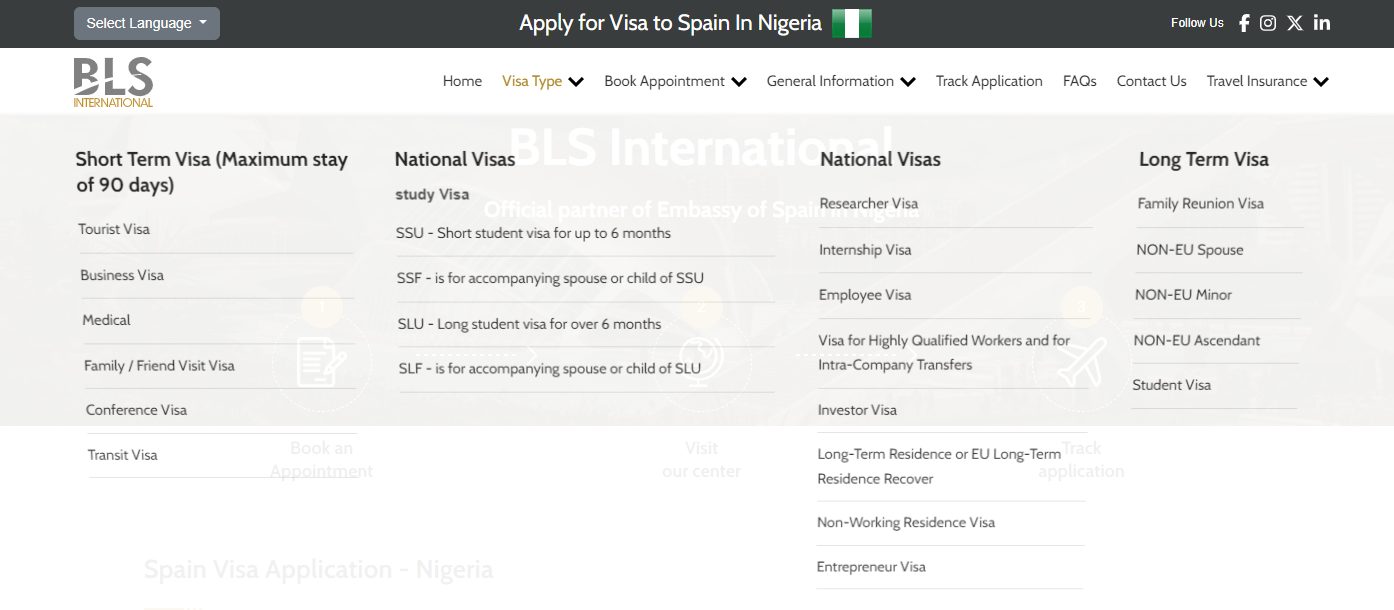
After identifying the visa application facility, the second important thing that the applicant must do is to determine the visa type. Applicants who want to travel to Spain from Nigeria must possess a visa according to the purpose and duration of their visit. The following image elaborates on the different visa types and their allowed duration.
Thus, choose the one according to your choice.
Gather Required Documents
Furthermore, it is important to collect all the required documents as mentioned above. Make sure that every document meets the criteria set by the Spanish Embassy or the Consulate.
Fill Out the Application Form
Once the above step is completed, ensure to fill out the application form accurately and then sign it before submitting it. Both Schengen and National visas have separate application forms that you can download and print from the same BLS website. You can also read the guidelines on how to fill it out from the official Spanish Embassy website.

Book an Appointment
Appointment scheduling is an important step because walk-in submissions at the center or embassy are not entertained. Therefore, ensure that you complete this step early. This is due to the fact that appointment slots fill in too quickly, especially during peak travel season. Moreover, appointments are usually booked online. So, make sure to book an appointment online with the Spanish embassy or the desired visa application center (BLS).
After this, you will receive a confirmation message via email with the time and date of the appointment.
Visit the center
Then, applicants are advised to visit the center on the appointed day. This step comes with the submission of the documents and the application form, biometric data enrollment, and payment of the visa application fee. Additionally, if the authorities seem interested, they will request you to appear for a short visa interview to discuss your travel plans in detail.
Track Your Application
The second last step is to return to your home and wait for the processing period. Moreover, applicants can check the status of their application by providing their reference number and date of birth on the BLS official website.
Collect Your Visa
Lastly, once the visa is approved, the applicant will be notified to collect their passport along with the visa sticker. In case your visa is denied, you will receive a notification elaborating on the reasons for the refusal.
Visa Processing Time
The processing time for a Spain visa from Nigeria usually takes 15 working days. However, due to certain factors, the processing time can be extended. For example, this includes peak travel season or errors in the visa application form. Other than that, factors such as visa type, the workload at the embassy, and the country to which the applicant belongs also play a crucial role in this regard.
In such a case, the normal period for a Schengen visa gets extended to 45 to 60 days. Contrary to this, a long-stay visa may take around three to six months to reach a decision.
It is, therefore, suggested to apply at least a few weeks before your planned travel dates to avoid any delays.
Visa Fee
The visa fee varies according to the type of visa, the nationality of the applicant, and the age group to which the applicant belongs. Hence, the fee structure according to the visa type is as follows:
The visa fee for a Schengen short-stay visa is almost 106 US dollars.
- Adults (12 years and older)
- The Schengen visa fee for adults above the age of 12 is typically around 90 euros or 1,44,774 NGN.
- Children (6-11 years old)
- The fee for children between the ages of 6 and 11 is usually around €45 or 72,387 NGN.
- Minors (under 6 years old)
- Lastly, minors under 6 years old are FREE from visa fees and may not be charged to travel to any part of the world.
The visa fee for a long-stay National visa is 80 euros or 1,28,688 NGN. This is applicable to all subtypes of a Type D visa, including work, family reunion, or student visa.
Since applications are typically processed through BLS International in Lagos or Abuja, the VAC will charge an additional service fee of approximately 28,800 NGN.
Moreover, visa fees are subject to change due to the exchange rate. It is important to check the updated fee structure on the official website of the Spanish Embassy.
Spain Visa Application Center – Lagos
Applicants can apply for a visa at the BLS International Spanish visa application center in Lagos. For this purpose, look at the following details.
Address: 8 Professor Gabriel Olusanya Street, Off QMB Builder Mart Road, Elf Bus Stop, Lekki, Lagos.
Timings:
Passport Collection Time: 13:00 to 16:00 hrs (Monday to Friday)
Submission Time: 08:00 to 14:00 hrs (Monday to Friday)
Email: info.los@blshelpline.com
Phone: +2347080644900
What Led to the Rejection of the Spanish Visa from Nigeria?
Digital scrutiny and strict adherence to the new subsistence thresholds lead to the rejection of a visa. Look at the following points.
- Insufficient funds are one of the main reasons for rejection. For the present time, Spain has a requirement of €122 per day per person, with a minimum of €1,098.90 for the entire trip. If you do not have this, you will not get a visa.
- Unexplained large deposits or borrowed funds just before the application can be checked through a 6-month transaction analysis. This led to immediate rejection. Consulates look for natural financial behavior, not a large deposit.
- If you are unable to provide a clear reason to return, such as a job, property, or family, the consulate may suspect that you are not intending to return prior to the expiration of the visa.
- The use of generic or AI-generated cover letters that do not address the specific reason for the visit or vague travel itineraries without confirmed reservations for hotel and flight may cause rejection.
- The implementation of the EES in 2026 will give immigration authorities immediate access to your complete Schengen footprint, revealing any prior overstays or undeclared refusals in seconds. Therefore, a poor travel history will affect future visa applications as well.
- Lastly, errors in dates between flight and hotel reservations, untranslated documents (which must be in Spanish for National visas), or unauthenticated bank statements are just a few causes for rejection.
FAQs- Spain Visa from Nigeria
Look at this section for frequently asked questions for a Spanish visa.
1. Can applicants apply for a Spain visa online?
No. Nigerian applicants need to submit the visa documents at the embassy by visiting in person. You can complete certain steps of the process online, such as completing the visa application form and booking an appointment through the BLS portal.
2. For how long is a Spanish Schengen visa valid?
Normally, the validity period of a Schengen visa is 90 days out of 180 days. There are fewer chances to get it extended under certain conditions. For instance, force majeure or humanitarian reasons.
3. Does a Spain visa require the submission of biometric data?
Yes, it is required by the embassy for all visa applicants to provide their biometric data (fingerprints and photographs) while submitting the visa application. However, if you have recently traveled to any of the Schengen countries in the last 59 months or 5 years, you are exempt from this.
4. What is the best option to do in case of a Spain visa application rejection?
In case your visa application gets denied, you will receive a notification elaborating on the reasons for the refusal. Moreover, applicants can appeal the decision or can reapply after addressing the specific issues that caused the denial. The best option, though, is to reapply for a new visa, as the appeal process requires time and energy.
5. What is the process of a Schengen visa extension?
Generally speaking, extensions are not granted for a short-stay Schengen visa. Therefore, you must leave the Schengen Area before your visa expires. If you want to stay for more than 90 days, then you can apply for a long-term visa.
6. Can I travel to other countries with a Spanish visa?
Yes. A Spanish Schengen visa allows you to travel to the rest of the member states. However, ensure that Spain is your main destination or your first point of entry.
7. How can I track the status of my Spanish visa application?
You can track your application online via the BLS Tracking Tool. This requires you to use your reference number and date of birth while filling out the form.
8. Do I need to translate my documents into Spanish while applying for a visa from Nigeria?
For short-stay visa applications, documents in English are accepted at the Abuja and Lagos centers. On the other hand, a National visa application requires you to translate certain documents, including a medical certificate or a police clearance certificate, by a sworn translator. After that, they must be legalized by the Ministry of Foreign Affairs in Abuja.
9. Is travel medical insurance mandatory for a Spain visa from Nigeria?
Yes. Nigerian citizens are required to have travel medical insurance with a minimum coverage of worth 30,000 euros and must stay valid across the entire Schengen Area.
10. Do I need to buy a flight ticket before applying for a Spain visa?
No. The visa application process requires you to have a flight reservation to represent your travel plans. It is strongly advised to avoid purchasing a real ticket before your visa is officially approved.
Conclusion
The process of unlocking your Spanish adventure starts with a successful visa application. Hence, by understanding the application process, visa requirements, and by providing the necessary documents, applicants can navigate the process from Nigeria easily and with confidence.
Thus, for your ease, Schengen Flight Reservation for Visa will help you in providing top-notch and embassy-approved flight reservations, hotel bookings, and travel health insurance, etc.
Ta-da!
Read also:
Malta visa from Nigeria → Ready to travel to Malta from Nigeria? Read this detailed guide to understand the necessity of having a Maltese visa and the mandatory supporting documents.
Greece visa from Nigeria → Traveling to Greece from Nigeria as a tourist, a businessman, or a visitor, etc., has been made possible with a visa and the complementary essentials. Read this guide!
Netherlands visa from Nigeria → Nigerians applying for a Netherlands visa can go through this guide to learn about the vital application process, documents, fees, and processing time.
A little Bit About Us
At Schengen Flight Reservation for Visa, we make the often overwhelming visa process a breeze. With verifiable documents at unbeatable prices, you are covered with Flight Reservations/Itinerary/Dummy tickets, Hotel Bookings (Proof of Accommodation), and a Travel Insurance Policy.
But that’s not all. Our services and blogs on writing a cover letter for a visa make your application process even smoother.
Are you stuck on something? Check our FAQs section or connect with us anytime through our 24/7 Live Chat because your convenience is our priority.
Our Blog section is your ultimate guide to navigating the ever-evolving world of visa policies & requirements.
Whether you are curious about the visa requirements for any country, changing visa rules & regulations, or need a comprehensive guide about any topic or visa of any country, then simply type your Query in our Blog search bar & get the ultimate detail in just a click.
So, let’s make your visa journey seamless, informed & stress-free!
most searched articles