
Italy Visa from Nigeria – Application Process & Requirements

Obtaining an Italy visa from Nigeria is the first vital step for Nigerian citizens who are planning to visit, work, or study in Italy. Moreover, the country is a part of the Schengen Area; thus, having a valid Schengen or National visa gives you the opportunity to travel to the rest of the neighboring states freely.
Besides, Italy is famous for being rich in history, vibrant culture, and stunning landscapes. It’s a dream country for many travelers. This beautiful state has something to offer to everyone.
For instance, you can visit the country if you want to enjoy the historical view of the ancient streets of Rome, or to explore the beauty of Tuscany’s countryside, or to witness the romantic view of the canals of Venice. Furthermore, Italy is known for being a blend of ancient ruins, the world’s most famous art, and cuisines, which makes it a must-visit place for every explorer.
Therefore, Nigerian applicants need to submit their documents for short or long-stay visas through the authorized partners like TLScontact in Abuja or Lagos. The ideal processing time ranges from 15 to 45 working days to reach a decision.
So, you can go through the following article to learn about the essential details of the Italian visa application process for Nigerians. Along with that, you will get to know about the available visa types, the necessary documents, and the latest fee structure. Stay tuned!
Tidbit about Italy
Italy is a prominent country in Southern Europe. Moreover, it is famous for its different boot-like shape. The country is the birthplace of the Renaissance and the origin of the Roman Empire. Besides, Italy is a global cultural superpower that has more than 61 UNESCO World Heritage Sites than any other nation.
Also known as the Italian Republic, it is a founding member of the European Union having the world’s eighth-largest economy.
Essentials facts
- Rome is the capital city of Italy, which is often called the Eternal City. It is the historical and administrative heart of the country.
- The country has a population of almost 59 million inhabitants.
- The Euro is the official currency of Italy. It replaced the Italian Lira in 2002.
- Italy has a government style of unitary constitutional parliamentary republic, which is led by President Sergio Mattarella and Prime Minister Giorgia Meloni.
Region and geography
The geography of Italy is quite diverse, from the mountainous Alps in the north to the sunny Mediterranean coast in the south.
- The two main islands of the Mediterranean Sea are Sicily and Sardinia.
- The Apennine Mountains run throughout the Italian peninsula, from the north to its southern end.
- The country consists of 20 administrative regions, like Tuscany (known for its beautiful landscapes) and Lombardy (a key economic center around Milan).
- Two sovereign city-states (Vatican City and San Marino) are enclaves within the territory of Italy.
Economy and culture
The influence of Italy is felt by every nation in the world through its high fashion, iconic food, and luxury engineering.
- The country is famous for its regional cuisine, such as Neapolitan pizza, fresh pasta, and the best wine producers in the world.
- Its major industries include a highly developed northern part with machines, automobiles, and fashion, while the southern region relies on agriculture.
- Italy ranks fifth in the world in terms of tourism, with popular destinations including Venice, Florence, and Milan.
What is an Italy Visa from Nigeria?
An Italy visa from Nigeria is a legal authorization or a travel document required to enter and stay in the destination state for a specific purpose and period. Since Italy is a member country of the Schengen Area, a standard Type C Italian visa is the most common category among all, allowing the holder to travel freely across 29 European countries for up to 90 days.
Without a valid visa, the officers at the border will deny you entry to the target country. Why? Because Nigeria is not on the list of visa-free countries. Therefore, acquiring a suitable visa type before leaving your homeland is a priority.
Can Nigerians get an eVisa or a visa on arrival in Italy?
No. Nigerians are not eligible to get a visa on arrival or an eVisa for Italy.
Being a part of the Schengen Zone, Italy makes it mandatory for the citizens of Nigeria or Nigerian passport holders to obtain a standard sticker visa from the embassy or consulate of the target country before the trip.
Key realities of the application
- Unlike some other countries, Italy does not offer an electronic visa or arrival-based visa processing for Nigerians.
- Therefore, you have to go through the conventional visa application process that requires the authorities to place a physical sticker on your passport. Thus, you need to collect your passport before departure.
- Moreover, applicants are also required to attend a physical appointment at a visa application center (TLScontact) in Lagos or Abuja, which is mandatory to provide biometric data, including fingerprints and a digital photograph.
- The processing time varies based on the chosen visa type. However, the standard period is 15-20 business days. So, the recommended duration to apply for a visa is at least 3-4 weeks in advance.
Implementation of ETIAS
In late 2025, the EU and all the Schengen countries had started implementing the ETIAS system. However, this is only for citizens of countries that have visa-free access to Europe.
Since Nigerians require a visa currently, they will not be eligible for ETIAS (Electronic Travel Information and Authorisation System). So, they must continue applying for standard Schengen and National visas to visit the destination country in the Schengen Area legally.
What Are the Common Visa Types Offered by Italy to Nigerian Citizens?
Primarily, Italy offers two basic and major categories of visas to citizens of Nigeria. For instance, this includes the Schengen visa or Type C for short-stays and the National visa or Type D for long-term stays in Italy.
This is because Nigeria does not have a visa-waiver agreement with Italy. So, you must apply for any of these visa types before traveling to the destination state.
Schengen visa (Type C)
Originally, this visa type allows Nigerian citizens to stay in Italy and across the 29 countries within the Schengen Area for up to 90 days within a period of six months. In simple terms, with a validity period of six months, you can use it for ninety days.
Moreover, one important thing to note is that short-stay visas are rare to get extension. If it is possible, it can be due to humanitarian reasons, force majeure, or extreme medical conditions. However, you need to return to your home country before the visa expires.
Look at the following table containing the subtypes of a Type C visa, along with their description and additional documents needed.
| Visa type | Description | Additional requirements |
| Tourist visa | You can use this visa type for sightseeing, leisure, or vacationing. Moreover, you can also explore the country to its fullest. |
|
| Business visa | An Italian business visa grants the holder access to the country to attend business meetings, conferences, trade fairs, negotiations, or training sessions. |
|
| Visitor visa | A visitor visa is used for private visits to friends or family members who are legal residents of Italy having an Italian residence permit. |
|
| Medical treatment visa | If you are a patient seeking specific medical care in Italian hospitals, clinics, or authorized medical facilities, this is the most suitable visa option for you. |
|
| Sports/cultural/religious event visa | Individuals participating in tournaments, competitions, or recognized cultural or religious events need to get this visa from Nigeria before starting their journey to Italy. |
|
Airport transit visa (Type A)
A Type A visa is another category similar to a short-stay visa. But the difference lies in its validity period and the purpose for which you can use it. So, Nigerian citizens need to obtain an airport transit visa while transiting through the international zone of an Italian airport en route to a non-Schengen destination state.
However, this does not allow the visa holder to enter the country. Besides, it has a validity period of 48 to 72 hours, while you can catch your connecting flight or change your luggage carrier.
National visa (Type D)
This visa category is for stays exceeding 90 days and is specific to Italy. Moreover, if you succeed in obtaining a Type D visa, it may often serve as a first step toward getting a residence permit.
Ideally, these visas have a validity of six months or one year, depending on the purpose or duration of your stay in Italy.
You can easily apply for an extension for a National visa in case your visa is about to expire, but your purpose of visit is not fulfilled yet. However, this should be done before the current visa expires.
| Important: Most of the Type D visa applications require the applicant to get a Nulla Osta (which is an official No Impediment authorization or certificate) issued by the Italian authorities. Before having that, you cannot apply for a long-stay visa at the embassy in Nigeria. |
The following table contains the subtypes of a Type D visa, along with their description and additional documents needed. So, go through it attentively.
| Visa subtype | Description | Additional requirements |
| Work visa | This Type D work visa is suitable for both kinds of individuals. For instance, it covers salaried employment with an Italian company and self-employment (freelancing). |
|
| Family reunification visa | This visa allows the parent, spouse, or child to join their family member who is already living in Italy legally. |
|
| Student visa | An Italian student visa gives you the margin to enroll in a college/university for a higher degree, long-term courses, or specialized training. |
|
| Elective residence visa | This is the most appropriate type for individuals who are living a retired life. So, an elective residence visa is for those who want to live in Italy without working. However, they are supposed to demonstrate that they have a significant passive income, such as investments or pensions. |
|
| Digital nomad visa | This is one of the new visa categories introduced by the Schengen countries. This allows the remote worker or freelancers to live in Italy while working for foreign entities. |
|
| Re-entry visa | Lastly, those foreigners who previously had a residence permit but need a new visa to return to Italy after it was lost or expired need to apply for a re-entry visa. |
|
| Note: For all Type D visas, any Nigerian public document (birth/marriage certificates, police reports) must be legalized by the Nigerian Ministry of Foreign Affairs in Abuja and then translated into Italian by an embassy-recognized translator. |
Italy Visa Requirements For A Nigerian Citizen
If you are a Nigerian citizen and have a dream of visiting Italy, you first need to obtain an Italian visa to travel there. The process of applying for a visa seems to be difficult and full of trouble, but with the right information and preparation, it’s not a big deal.
The following section of this guide will help you learn about all the requirements, documents, and procedures to apply for an Italy visa from Nigeria. We will ensure that you get all the necessary information about the complete visa application process.
General Document Checklist for an Italy Visa from Nigeria
After the identification of the suitable visa for your purpose of visit, you need to gather all the required documents according to the demands of the embassy. The list of general documents required for all visa types is as follows.
Besides, the above section contains the visa types, and along with them, additional documents particular to a specific visa category are also discussed. So, if you are applying for an Italian tourist visa, you need to bring the following general documents plus the mentioned-above extra essentials for a tourist visa to your appointment at the visa application center.
Visa Application Form

The first step towards getting a visa in Italy is to fill out and sign the visa application form for submission. Hence, you can get your visa application form from the official website of the embassy.
Make sure to fill in all the information with clarity and accuracy. So that there are no chances of errors and delays in the process of the visa application form.
Usually, the application form consists of four sections:
- Personal details
- Travel information
- Place of stay (Accommodation details)
- Signature of the applicant and date
The information provided must align with the rest of the submitted documents, such as your full name, date of birth, passport number, etc. In case of a mismatch, the application will lead to rejection.
Valid Passport
The applicants are required to have a valid Nigerian passport to travel to Italy. Moreover, it must fulfill certain requirements as stated by the Italian authorities. This includes,
- Your passport must have two blank pages for the visa stamps (arrival and departure).
- It should be free from any uncertain markings and unusual changes.
- Check the expiry date of the passport. It should not be older than the last ten years.
- Moreover, your passport must have a validity period of at least three to six months beyond your departure from the target state.
If your passport is about to expire or is unable to fulfill the above-mentioned requirements, try to renew it immediately. Because it is a requirement that your passport should have an expiry date of at least three to six months after your return from the destination country.
Photos
Another requirement for an Italy visa from Nigeria is to have two recent passport-size photos. These are required by the embassy as part of the visa application process. Also, ensure to fulfill the following Schengen visa photo guidelines before submitting and attaching them to the visa application form.
- The photos should be recent, i.e., not older than the last three to six months.
- In addition, your face should be visible in these photos. So, the photo must cover at least 70-80% of the face and shoulders.
- They should be free from any signs of staples or ink marks.
- The ideal dimension of the visa photos is 35*45mm.
- The pictures must have a background of white or plain.
- The photos should be of HD quality, colored print, and matte finish.
- Last but not least, avoid wearing any accessories, such as hats or glasses, except for religious purposes only.
Flight Reservations

Flight reservations assure the embassy of your serious intentions to visit the destination country. Reserving a flight is different from actually paying for a flight ticket. Booking flight reservation for visa rather than purchasing a confirmed flight ticket is more beneficial as it gives you time to rethink your travel plans.
Moreover, in case of application rejection, you can save potential money that could have been lost if you had spent thousands of dollars on a real ticket.
This flight itinerary contains a summary of all your travel plans. Hence, flight reservations work as an outline of the intended departure from the target country. It restricts the visa holder to avoid overstayying their visa illegally to save themselves from legal consequences.
Required Information For Reservations
Make sure to provide complete and accurate information about your travel plans, which can be validated by the authorities. Such as
- Your complete name
- Traveling dates (departure and arrival in the destination country)
- Airline name
- Confirmation message of the reservation
- Reservation ID
- 6-digit PNR (passenger name record)
- Departure and arrival airport names
- Luggage weight
Make sure to reserve your flight reservation for visa from an authentic website, so that authorities can validate it when required. Always try to have flexible dates for flight reservations.
Accommodation Proof

The proof of accommodation is a requirement that needs to be fulfilled when applying for an Italy visa from Nigeria. Because the purpose of hotel booking for visa application is to show your place of stay in the destination country.
Thus, you can provide your accommodation plan in the form of hotel reservations or by showing the letter of invitation from the host in the destination country. Another document that you can submit is the rental agreement for a house or an apartment.
In both cases, you need to provide the complete details of the place where you are staying, including your name, location, and the name of the place, and the duration you want to stay there.
If you are providing a letter of invitation as proof of your accommodation plan, then you need to provide the passport copy and the resident permit of your host, along with the invitation letter. Make sure to provide the accommodation proof for your complete stay in the destination country.
Travel Insurance

A travel health insurance policy not only provides security during your international travels but is also required by the authorities as a necessity. A valid insurance provides you with at least the minimum coverage amount set by the destination country. Since Italy is a Schengen state, ensure to meet the following criteria.
- The minimum coverage amount of travel insurance set by the Schengen countries is €30,000.
- A valid health insurance policy makes sure that you have access to all the required and basic health care facilities during your stay in the destination country. For instance, this includes accidents, surgery, death, repatriation, evacuation, luggage loss, flight cancellation, passport loss, etc.
- In case of any unfortunate event or accident, travel health insurance companies are responsible for providing you with the proper medical care. This may include hospitalization and traveling to the home country for treatment or other reasons.
- Furthermore, your insurance must stay valid for the entire duration of your stay in Italy and cover the whole Schengen Area.
The authorities will validate your travel insurance visa application along with all other requirements. Therefore, choose an authentic and well-reputed travel insurance company for your travel health insurance to avoid troubles.
Financial Proof
It is important to provide proof of your financial stability while traveling internationally. The evidence can be in any form, including:
- A letter of employment
- It can be your recent bank statements from the last three to six months
- Any savings can prove that you are financially capable enough to afford the expenses of the host Schengen country.
Moreover, if an organization or a relative is sponsoring you, they need to provide complete documentation, including a letter of invitation from your host in the destination country.
You can also submit a sponsorship letter, salary slips from the previous three to six months, or income tax returns showing the balance of the past two to three years. Besides, travelers’ cheques and credit/debit card details can also help the authorities assess your financial health. You need to have the desired balance to manage your daily food, transportation, and accommodation in Italy.
Purpose Of Financial Proof
The purpose behind demanding proof of financial stability is to make sure that the applicant is financially capable enough to afford all the travel expenses. The embassy makes sure, before granting the visa, that the applicant is not going to be a trouble for the destination country. Also, the applicant has enough means to support themself completely without relying on the resources of the destination country.
Cover Letter

A cover letter is an additional document that helps applicants to present themselves convincingly in front of the authorities. A cover letter contains all the personal information of the candidate. It should always be written concisely in a professional tone.
The best way to write a cover letter is to start with your introduction. Then, briefly provide your travel information. You can also provide an overview of your complete trip. Do not forget to disclose your plan of return and intended activities in the target state.
This is your best chance to convince the visa officer to grant you the visa, as you are the most suitable candidate in this regard.
Where Can You Apply for an Italian Visa?
If you are currently living in Abuja and looking for a trip to Italy, you might be interested in knowing the address, phone, or office hours of the Embassy of Italy in Abuja.
Address: European Union Crescent, CBD, Garki, Abuja.
Phone: +0023494602970|0023494602971
Email: ambasciata.abuja@esteri.it
How to Apply for an Italy Visa from Nigeria: Step-by-Step Process through TLS Contact
Italy has its Embassy in Abuja, along with the Consulate in Lagos. Though the Italian Embassy and the Consulate of Italy play a vital role in the visa application process, applicants from Nigeria need to submit their visa applications for Italy to the third-party center, TLScontact. You can find such centers in Abuja and Lagos.
Lodging your applications through TLScontact is more feasible, as it provides certain online services, including appointment booking and application tracking. Thus, follow these steps to have a successful visa application process.
Determine the Visa Type You Require

It is important to learn about the visa type you need according to the purpose of your visit. Italy offers different types of visas according to the requirements of the travelers. This has been discussed in detail in the section above.
However, some of the prominent visa types are listed here. This includes:
- Business visa
- Student visa
- Visit visa
- Tourist visa
- Work visa
Go to the TLScontact website
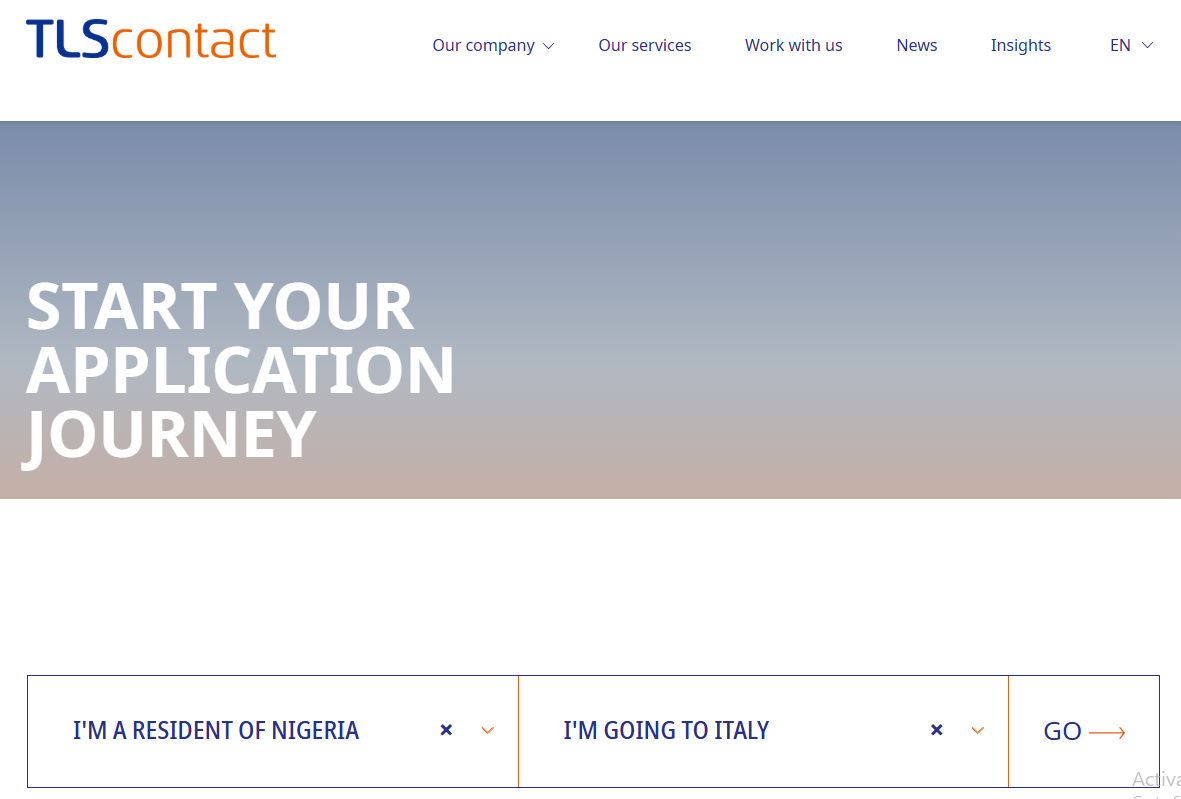
Visit the TLScontact web page. Once the homepage is visible, you need to select the country of your origin (Nigeria) and the destination state to which you are planning to travel (Italy). Hit the button ‘Go’ to move ahead.
Book your appointment
The next page requires you to select the button that says ‘book your appointment’. This again gives you the option of the area of your residence.
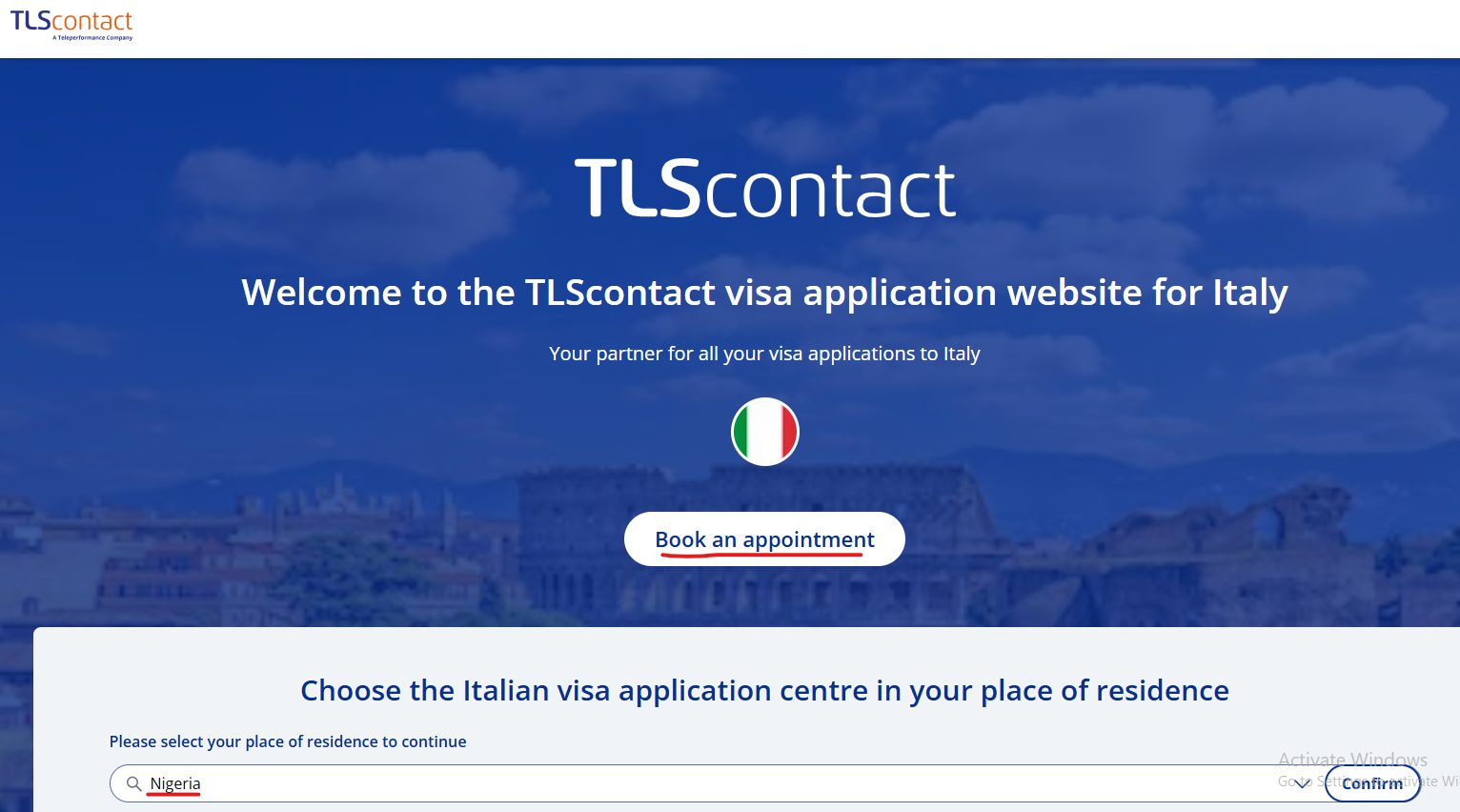
Then, you can move to the next step of the visa application process. Select an appointment date and time. The appointment will get registered in your account, and you will receive a confirmation email.
Choose your visa application center
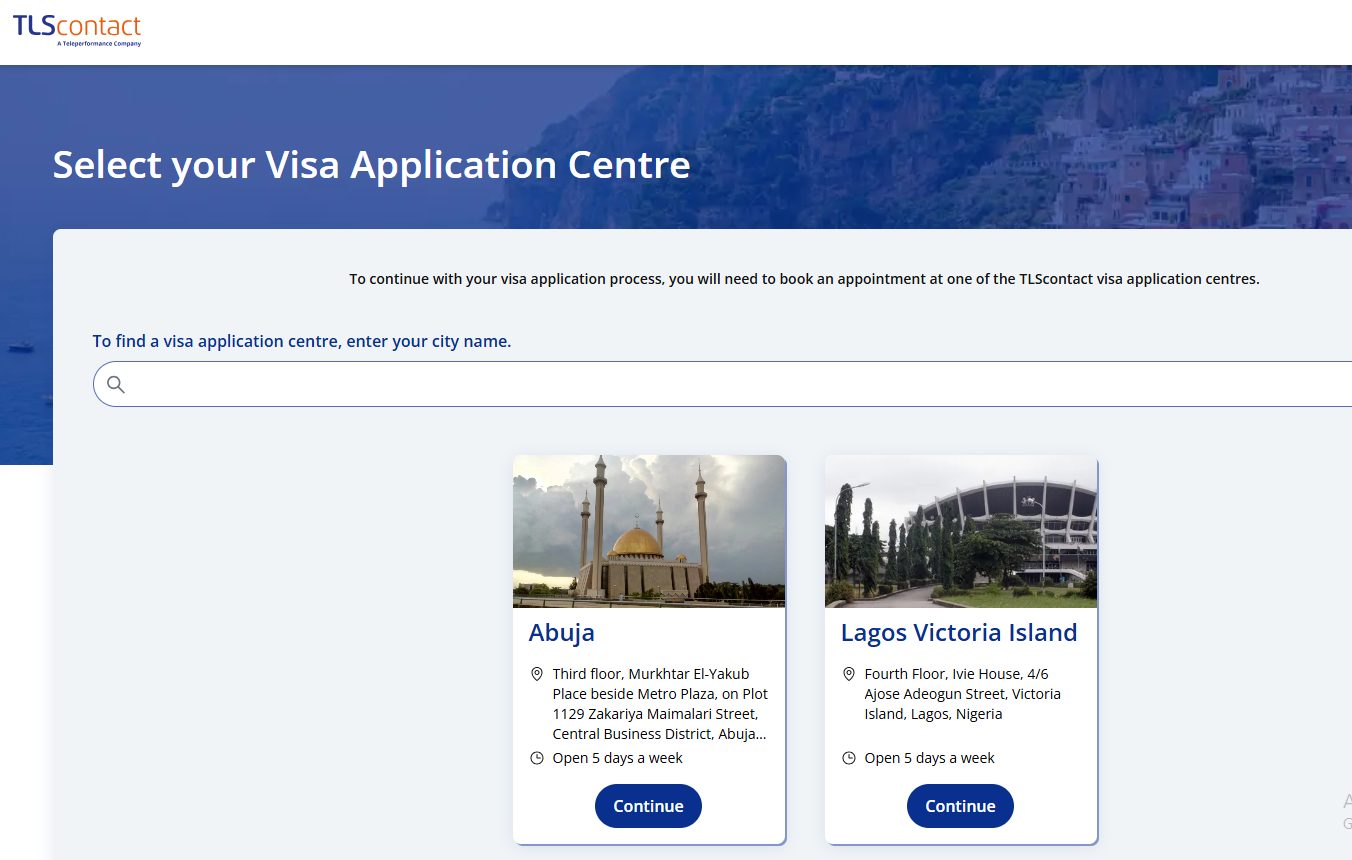
Select the visa center where you want to submit your visa application and press continue. If you have clicked on the wrong place, you can go back to re-enter. You will see all the centers on your screen where you can apply. Choose the nearest one for your convenience. For instance, TLScontact has two centers in Nigeria, located at the following addresses.
Lagos Center: Fourth Floor, Ivie House, 4/6 Ajose Adeogun Street, Victoria Island, Lagos.
Abuja Center: 3rd Floor, El-Yakub Place, Plot 1192 Ahmadu Bello Way, Central Business District, Abuja.
Create an account
Click on the right corner of the screen to create your TLS account. Provide all your details in the form, such as your email address and password. After accepting the terms and conditions, you can successfully create your account. Enter all your travel details and contact information. Log in and start your application.
Moreover, do not forget to complete the visa application form that you can get from the same site. Provide accurate details according to the rest of the accompanying documents.
Prepare your documents
Once your application has been registered and the account has been validated, you can check the list of required documents according to your visa type.
For reference purposes, you can go through the sections above containing a list of the mandatory and supporting documents. Also, ensure that all the documents are in Italian or English.
Go to the visa application center
Visit the TLS visa application center on your appointed date. Take all the necessary documents with you. Finally, you can submit your application and wait for the processing time.
The wait time depends on the visa type you apply for. A standard Schengen visa may take around 15-40 days. You can also track the status of your application in the meantime if TLScontact provides an online tracker. Moreover, you can visit the center to get updates about your Italian visa application.
Collect your passport
At last, if your application is approved, you will receive an email to collect your visa-stamped passport on the specific date and time. If available, you can get it delivered to your home through a courier service at additional charges.
Italian Visa Fees for Nigerians
As of June 11, 2024, the normal charges for obtaining an Italian visa from Nigeria have risen because of the global change in Schengen visa charges. The fees consist of the Embassy fee (in Naira, according to the current exchange rate) and the TLScontact fee.
- Schengen visa for adults over 12= 90 euros or 1,45,260 ₦
- Schengen visa for children between the ages of 6 and 12= 45 euros or 72,630 ₦
- Minors under six= Free
Contrary to this, you need to pay 116 euros or 1,87,224 ₦ for a National visa and a reduced fee of 50 euros or 80,700 ₦ for a study visa.
Besides the embassy visa charge, there is the processing fee (20,000 to 30,000 ₦) payable at the TLScontact Visa Application Centre in either Lagos or Abuja.
Important points:
- The Embassy regularly updates the internal exchange rate. This determines how much Naira equivalent you have to pay and not the market/black market exchange rate.
- Visa and service charges are non-refundable, whether your visa is granted or not.
- Fees are generally paid in cash (Naira) at the bank inside the TLScontact office during your appointment.
Mistakes To Avoid for a Successful Visa Application Process
By avoiding common mistakes, you can save time and get your visa for Italy approved from Nigeria because the smallest errors and mistakes can lead you to trouble and delays.
Mentioned below are some of the most typical visa rejection reasons that you must avoid.
- An incomplete or Incorrect visa application form, such as leaving any field empty or entering the wrong passport number.
- Insufficient proof of financial resources. Having inadequate balance or sudden large deposits are the biggest red flags in the visa application process.
- Lack of proper travel insurance. This includes insufficient coverage amount or invalidity for the entire Schengen Area.
- Missing or inconsistent supporting documents. This may include a travel itinerary or proof of strong economic ties.
- Incorrect specifications for the photographs also lead to the rejection of the visa.
- Submitting fake or forged documents. For instance, a dummy ticket having a fake PNR or unverifiable status.
- Ignoring the interview requirement. If requested, you need to be present at the center to attend the interview. Otherwise, your application will be discarded.
- Inadequate explanation of travel purpose, such as choosing the wrong visa type that does not align with the purpose of your trip to Italy.
- Lastly, applying too late, past the date of the event or the ceremony in the target state, will lead to rejection.
FAQs- Italy Visa from Nigeria
Learn about the following FAQs related to the application process for an Italy visa from Nigeria.
1. Are Nigerians required to get a visa to travel to Italy?
Yes. Nigerian passport holders must get a Italy visa, i.e., a Schengen visa for short stays and a National visa for long stays, before traveling to the host country. Nigeria is neither on the list of visa-free countries nor does it have an option of a visa on arrival or an eVisa.
2. Where should I apply for an Italian visa in Nigeria?
Schengen countries have outsourced a third-party visa application center for the processing of the applications. Therefore, for an Italy visa from Nigeria, you can lodge your applications through TLScontact centers located in Abuja (Central Business District) and Lagos (Victoria Island). Make sure to book an appointment before visiting the center.
3. How much does an Italy visa cost for citizens of Nigeria?
The standard fee for a short-stay visa for all the Schengen countries is 90 euros for adults above the age of 12. However, children between the ages of 6 and 12 must pay 45 euros. Contrary to this, a National visa may cost 116 euros for Nigerian citizens. Other than that, you are also required to pay the TLScontact mandatory service charges, i.e., 20,000 to 30,000 ₦.
4. How long does the Italian visa processing take for the citizens of Nigeria?
For a Schengen Italian visa, the standard processing time is 15 business days. But it gets extended up to 45 to 60 days under rare circumstances. For instance, this includes peak summer and winter seasons that may require extra security checks.
5. Can I travel to other Schengen countries if I have a valid Italian visa?
Yes. Once you have a valid Italian visa, you can travel to any of the 29 member states within the Schengen Area. This includes France, Spain, or Germany. This can be done without obtaining a separate visa. But, ensure that Italy is your primary destination or first point of entry.
6. Is travel insurance mandatory for an Italy visa from Nigeria?
Yes. Traveling to any of the Schengen states requires you to provide proof of travel health insurance. Moreover, it should have a coverage amount of at least 30,000 euros. In addition, it must cover the entire Schengen Region and be valid for the total duration of your stay in Italy.
7. What is a Nulla Osta, and do I need to have it?
A Nulla Osta is an official authorization that is issued by the Italian provincial authorities. This document is mandatory for long-term visas, such as work or family reunification visas. Your Italian host or employer in Italy must apply for it from Italy first. After that, you can start the Type D visa application process.
8. Should I apply for an Italy visa from Nigeria if my passport expires in 4 months?
Generally, no. Your passport must have a validity period of at least 3 to 6 months beyond your planned departure from the Schengen Area or Italy. Apart from that, your passport must contain at least 2 blank pages for visa stamps.
9. What are the common reasons for Italian visa denials for Nigerians?
The typical reasons that lead to the rejection of the visa include insufficient proof of financial means, submitting forged/altered documents, inadequate ties to the home country, or inconsistent travel itineraries (unconfirmed hotel bookings).
10. Do I need a Polio vaccination certificate to apply for an Italy visa from Nigeria?
Yes. The ongoing international health regulations require the Nigerian applicants to provide an International Certificate of Vaccination (Yellow Card). The document will demonstrate that the particular applicant has gone through the Polio vaccination recently.
Conclusion
It is important to plan carefully and follow official rules for securing an Italy visa while living in Nigeria. This procedure entails legalized documents and particular health conditions that can be met by going through the Italian Embassy and TLScontact.
Moreover, you can rely on SFRV Travels to obtain embassy-approved documents at a market-competitive price. Get your visa, pack your essentials, and embark on your Italian journey.
Bon Voyage!
Travelers Also Liked:
Finland visa from Nigeria → Learn the complete process of applying for a Finland visa from Nigeria, including requirements and application tips.
Iceland visa from Nigeria → Explore the complete process for obtaining an Iceland visa from Nigeria, from eligibility and documentation to visa appointment details.
Greece visa from Nigeria → Find out how to apply for a Greece visa from Nigeria with details on documents, fees, and visa categories.
A little Bit About Us
At Schengen Flight Reservation for Visa, we make the often overwhelming visa process a breeze. With verifiable documents at unbeatable prices, you are covered with Flight Reservations/Itinerary/Dummy tickets, Hotel Bookings (Proof of Accommodation), and a Travel Insurance Policy.
But that’s not all. Our services and blogs on writing a cover letter for a visa make your application process even smoother.
Are you stuck on something? Check our FAQs section or connect with us anytime through our 24/7 Live Chat because your convenience is our priority.
Our Blog section is your ultimate guide to navigating the ever-evolving world of visa policies & requirements.
Whether you are curious about the visa requirements for any country, changing visa rules & regulations, or need a comprehensive guide about any topic or visa of any country, then simply type your Query in our Blog search bar & get the ultimate detail in just a click.
So, let’s make your visa journey seamless, informed & stress-free!
most searched articles