
Everything You Need to Know About South Korean Visa Process for Indians

So, this country provides different kinds of visas for travel, business, and academic purposes. For some Indians, yet, the visa application procedure can be challenging. It is easy to handle if you are aware of the requirements and process. Moreover, having the proper visa will allow you a peaceful and joyful stay in South Korea. Thus, feel free to go through this article to learn all the essentials of the South Korean visa for Indians.
Why You Should Visit South Korea?
Visiting Korea is a great idea. The following are the top reasons for that.
Rich Cultural Heritage
The country has a deep and engaging cultural heritage. Travelers can visit the old temples, grand places, and UNESCO World Heritage sites. Cities like Seoul represent the cultural richness of the country, while old cities like Gyeongju present a glimpse of old Korea.
Modern Attractions
South Korea is known as the leader in technology and modern attractions. Moreover, visitors can also see a futuristic cityscape in Seoul with tall buildings and high-tech infrastructure. Korea makes sure that travelers have an exciting and dynamic experience with its high-tech parks and lively nightlife.
Natural Beauty
The natural beauty in South Korea is stunning. Such as ranging from picturesque landscapes to soothing beaches and majestic mountains, Korea has everything to offer its visitors. Korea’s Jeju Island is one of the most famous destinations for travelers due to its beautiful beaches and volcanic landscapes. Moreover, the national park of Seoraksan offers breathtaking views and hiking trails.
Shopping and Entertainment
If there is a heaven in the world for shopping with bustling markets, elite malls, and unique local shops, it’s South Korea. Whether you are looking for traditional Korean stuff or in search of the latest fashion trends, you can find it all here.
The whole world knows about K-pop music, K-dramas, and Korean cinema, which offer their viewers a rich cultural experience and insights. Hence, Korea is famous for its entertainment industry.
What is a South Korean Visa for Indians?
A South Korean visa for Indians is an official document or endorsement that allows the holder to enter, stay, and exit the country legally. The particular visa type should be selected based on the purpose of your visit to the destination country. This may include tourism, employment, or business purposes.
| Note: Unlike other countries, Indian citizens are not eligible for a visa-free entry to South Korea. Furthermore, they do not have the opportunity for K-ETA (Electronic Travel Authorization) for general trips. |
Do Indians Need a South Korean Visa?
Yes, Indians planning to visit South Korea need a visa to enter. The Indians do not have the facility to get a visa on arrival. Thus, based on the purpose of the visit, you can apply for a different South Korean visa for Indians.
What are the Eligibility Criteria for a South Korean visa for Indians?
The Indians must meet the following criteria for a South Korean visa before applying. So, look at the following points:
- You must be a citizen of India and have a valid Indian passport.
- Also, you must have a valid reason to enter South Korea.
- No criminal record, and you must provide a police clearance certificate (PCC).
- Moreover, you must have money to support your stay in South Korea.
- A strong bond with your home country is a must, as it guarantees your return to your home country.
Which Indians are Exempt from South Korean Visas?
Most of the Indians are eligible for South Korean visas. Yet, there are some Indians who might not be able to get a South Korean visa.
So, their visa is rejected due to the following issues.
- The applicants have incomplete or incorrect documents.
- Indians have a criminal record.
- Those applicants who have previous visa violations.
- The Indians have health-related and security concerns.
- Indians who are financially unstable.
- Those applicants who provided false or misleading information.
Types of South Korea Visa
When selecting your visa, it is important to consider not just your immediate plans but your potential future travel frequency. South Korea has meticulously streamlined its visa categories to cater to the growing demographic of Indian digital nomads, entrepreneurs, and luxury travelers.
1. Short-Term Visas (Stays up to 90 Days)
These are the most common visas for general travel purposes and generally fall under the “C” type category.
- C-3-9 (General/Short-Term Tourist Visa):
- Purpose: This is the standard visa for the majority of Indian travelers visiting for leisure trips, sightseeing, cultural experiences, or visiting family.
- Validity: Typically allows a single continuous stay of up to 90 days.
Pro-Tip: If you have previously traveled to South Korea, mention this clearly in your cover letter to establish a positive travel history, which often speeds up the verification process.
- C-3-4 (Short-Term Business Visa):
- Purpose: For individuals traveling to attend business meetings, sign contracts, conduct market research, participate in corporate training, or attend international trade fairs.
- Requirements: In addition to standard documents, you must provide an invitation letter and a business registration certificate from the inviting Korean company.
| Note: This visa is strictly for non-remunerative business activities. If you are being paid a salary by a Korean company for work done in Korea, you must apply for an E-type (Employment) visa instead. |
2. Long-Term Visas (Stays Exceeding 90 Days)
For those planning extended stays for academic pursuits or specialized work, specific long-term visas are necessary.
- D-2 (Student Visa – Regular Study):
- Purpose: Issued to students accepted into full-time degree programs at recognized Korean universities.
Pro-Tip: Ensure your “Certificate of Admission” is the original version issued by the university, as digital copies are sometimes scrutinized or rejected at certain application centers.
- D-4 (Student Visa – General Trainee):
- Purpose: Issued for non-degree programs, such as language institutes or vocational training.
| Note: D-4 visa holders often face stricter part-time work regulations than D-2 holders. Always check the latest 2025 guidelines from the Korea Immigration Service regarding work permits for students. |
3. Special Category: Multiple-Entry Visa
For frequent flyers and established professionals, a multiple-entry visa offers long-term flexibility.
- Eligibility Criteria for Indians:
- Frequent Travelers: Those who have visited South Korea multiple times or hold a valid visa for OECD member countries (e.g., USA, UK, Australia).
- Professionals: High-ranking professionals (Doctors, Lawyers, Chartered Accountants) and executives of reputed firms.
- Benefits: Typically grants a validity of 5 to 10 years, allowing multiple entries with a stay duration of 30 or 90 days per visit.
Pro-Tip: If you qualify for a Multiple-Entry Visa, it is highly recommended to apply for it even if your current trip is short. It is cost-effective in the long run and serves as a strong addition to your passport for future international visa applications.
What Is the Validity of South Korea Visas?

Hence, below is the table showing the validity of different South Korean visas.
| Visa Kinds | Validity |
| Single Entry Tourist Visa | Valid for 3 months |
| Single Entry Business Visa | Valid for 3 months |
| Multiple Entry Visa | Valid for 6 months |
Essential Documents for a South Korean Visa
To secure a South Korea visa in 2025, the quality and accuracy of your paperwork are the most influential factors in the decision-making process. The consulate expects a comprehensive narrative of your trip, supported by authentic evidence of your ties to India and your ability to fund your stay. Visa supporting documents that are required are given below:
1. The Passport
Your passport serves as the foundation of your application and must be the original physical booklet.
- Validity: The document must remain valid for at least six months beyond your intended departure from Seoul.
- Space: It must contain a minimum of two blank pages for official use and entry stamps.
- History: Including copies of previous visas, especially from OECD nations like the USA, UK, or Schengen countries, can significantly strengthen your profile.
Pro-Tip: If you have recently renewed your passport, always submit your expired passport alongside the current one to demonstrate a long-standing, positive international travel history.
2. Visa Application Form
This document acts as your formal introduction to the consular officers and must be filled out with absolute precision.
- Source: Use the latest version downloaded directly from the Korea Visa Portal.
- Language: Every section should be completed in English using clear block letters.
- Accuracy: Your signature at the end must match the one found on your passport’s bio-page.
| Note: Avoid leaving any fields blank; if a section does not apply to your specific situation, simply write “N/A” to show that the section was not overlooked. |
3. Photographs
You must provide two recent color photographs that adhere to strict biometric standards to ensure they are compatible with South Korea’s digital visa systems.
- Dimensions: These images should be exactly 3.5cm x 4.5cm.
- Background: The photo must feature a neutral expression against a stark white background with a matte finish.
- Appearance: Ensure your face is centered and both ears are clearly visible without any hair or accessories obstructing them.
4. Flight Reservation
A round-trip flight reservation for visa application is necessary to prove that you have a concrete plan to exit South Korea before your visa expires.

- Information: This should show your full name, specific flight numbers, and dates for both your arrival and return journeys.
- Status: It is generally recommended to use a verifiable reservation or “hold” rather than a fully paid ticket during the initial application phase.
Pro-Tip: Use a service that provides a live PNR (Passenger Name Record) that can be verified on the airline’s official website, as consular officers occasionally check these records to confirm the booking is active.
5. Proof of Accommodation
You must demonstrate where you intend to reside every night of your stay in South Korea to prove the legitimacy of your visit. This usually takes the form of hotel booking confirmations listing the hotel’s address and contact information.
The dates on these bookings must align perfectly with your flight itinerary and the dates mentioned on your application form.

| Pro-Tip: If you are staying in multiple cities like Seoul, Busan, and Jeju, ensure you provide the reservation receipts for each location to show a complete and logical travel path. |
6. Cover Letter
This is a self-signed letter addressed to the Consul General, where you explain the “why” behind your trip.
- Core Content: Clearly outline your travel dates, the primary purpose of your visit, and who is financing the trip.
- Itinerary: Provide a brief day-by-day breakdown of your planned activities to show you are a genuine tourist.

A well-written cover letter can bridge gaps in your documentation; for example, if you are a freelancer, use this letter to explain your work nature and how you manage your income.
7. Proof of Finances
This is the most heavily weighted part of the application, intended to prove you can support yourself without seeking illegal work. Submit original stamped and signed bank statements for the last six months showing a healthy balance.
Provide Income Tax Returns (ITR-V) for the last two to three years as proof of financial stability in India. Include your last six months of salary slips or business income records.
Note: Avoid making large, unexplained deposits into your account just before applying, as this can be viewed as “funds for show” and may lead to rejection.
8. Travel Medical Insurance
While South Korea has simplified many entry processes for 2025, carrying comprehensive travel insurance remains a hallmark of a prepared traveler.
- Coverage: A good policy should offer high coverage for medical emergencies, accidents, and repatriation (typically a minimum of $30,000).

Opting for a policy that includes “COVID-19 coverage” and “Trip Cancellation” provides an extra layer of security and demonstrates to the officer that you are financially protected.
9. Other Supporting Documents
Depending on your professional background, specific additional evidence may be required.
- Employment: A NOC (No Objection Certificate) from your employer on company letterhead.
- Business: A copy of your GST registration or partnership deed if you are self-employed.
- Invitation: For business or family visits, an invitation letter from the Korean entity or resident, along with their ID or business registration copy.
| Pro-Tip: If you are a student, including a copy of your ID card and a leave approval letter from your educational institution will help clarify your status and intent to return to India. |
Steps to Apply for a South Korean Visa from India
To secure a South Korea visa from India in 2026, travelers must navigate a specific set of procedures involving both digital applications and physical document submissions. As of January 6, 2026, the South Korean government has implemented a streamlined electronic system, and specific fee waivers remain in effect for group travelers until June 30, 2026. This guide details the step-by-step process to ensure your application is successful and your travel plans remain on track.
Step 1: Decide Your Visa Type
Before starting your application, carefully consider the primary purpose of your visit, as this determines the criteria you must meet.
- Tourist Visa (C-3-9): This is the most common choice for those traveling for leisure, sightseeing, or visiting relatives residing in Korea.
- Business Visa (C-3-4): This category is mandatory if you are traveling for professional reasons like attending conferences, market research, or business negotiations.
- Group Tourist Visa (C-3-2): This is specifically for those traveling with an authorized travel agency and is the only category eligible for the 2026 fee waiver.
Review the specific conditions for each category on the official portal to ensure it match your travel needs perfectly before you proceed to documentation.
Step 2: Assemble the Necessary Documents
Once your category is chosen, you must collect a comprehensive dossier of documents. Incomplete files are the leading cause of visa delays or immediate rejections.
- Passport: You must provide your original passport, which must be valid for at least 6 months and contain at least two blank pages.
- Photographs: Two recent 3.5 x 4.5 cm color photos taken against a plain white background are required to meet biometric standards.
- Financial Proof: You must submit signed and stamped 6-month bank statements and your Income Tax Returns (ITR) for the last 2 years.
- Employment Proof: Employees must provide a signed No Objection Certificate (NOC) and salary slips, while business owners should provide company registration documents.
- Travel Details: You are required to show confirmed return flight tickets and hotel reservations for the entire duration of your stay.
All the other details of the documents are given above.
Step 3: Identify Your Submission Center
South Korean visas in India are not submitted directly to the Embassy but through authorized partners like the Korea Visa Application Center (KVAC) or VFS Global.
- New Delhi: The VFS Global center is conveniently located at the Shivaji Stadium Metro Station in Connaught Place.
- Chennai: Southern applicants should visit the KVAC at Ramee Mall, Anna Salai, for all submission requirements.
- Kolkata: The VFS Center at Rajdanga Main Road serves as the primary hub for applicants from the eastern region.
Contact Information: You can reach the central helpline at (+91) 22-62018463 for appointment queries or email info.korea.in@vfshelpline.com for specific document advice.
Apply Through the South Korean Embassy
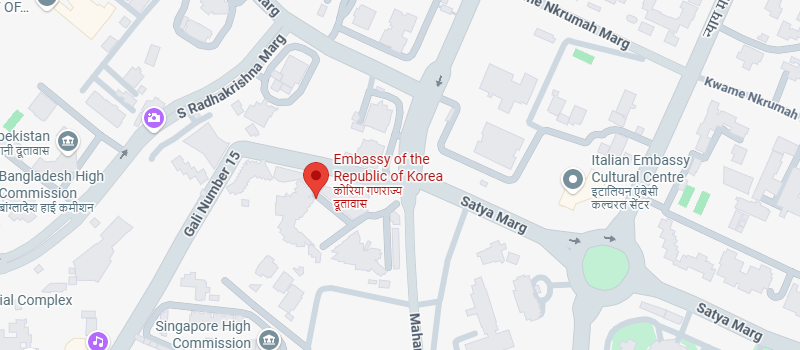
The Indian applicants can also apply for a visa through the South Korean Embassy in India. For this purpose, follow the same steps discussed in this section.
Address: H5RJ+34Q, 9, Chandragupta Marg, Chanakyapuri Extension, Chanakyapuri, New Delhi, Delhi 110021, India
Phone number: +911142007000
Step 4: Fill Out the Visa Application Form
The next phase is the digital application, which serves as the foundation of your request. Accuracy during this step is vital to avoid any inconsistencies that might lead to a visa denial.
- Access the Portal: Visit the Korea Visa Portal and navigate to the application section to fill out the form.
- Verification: Provide complete and accurate details; double-check that your name and passport number match your physical passport exactly.
- Physical Copy: After submitting the form online, you must download, print, and sign it, as this physical copy must be included in your submission folder.
Step 5: Schedule the Visa Appointment
While some centers allow walk-in submissions during specific morning hours, it is highly recommended to schedule an appointment to manage your time better and avoid long queues.
Call the designated center numbers or use their online portal to book a specific date and time for your submission. Note down your slot carefully and aim to arrive at the center at least 15 minutes early to clear security and organize your papers.
Step 6: Attend the South Korean Visa Interview
In some cases, you may be required to attend a brief interview with a visa officer to clarify specific parts of your application.
- Purpose: The officer’s goal is to verify the details in your application and ensure your intent is consistent with the visa category you selected.
- Preparation: Be ready to answer questions regarding your daily itinerary, your financial stability, and your firm’s plans to return to India after your trip.
Step 7: Pay Your Visa Fee
Payment is a mandatory step and is usually required at the time you submit your physical documents at the application center.
- Costs: The standard single-entry fee is approximately ₹3,600, plus a mandatory center service charge of roughly ₹1,380.
Remember that group tourists are currently exempt from the main visa processing fee until June 30, 2026, though they must still pay the service charge.
Step 8: Wait for Application Processing
After submission and payment, your application enters the formal review phase by the South Korean consulate.
- Duration: Standard processing generally takes 10 to 15 working days, though this can vary during peak holiday seasons.
You will typically receive an automated confirmation email once the embassy has reached a final decision on your application.
Step 9: Track Your Application
You do not have to wait blindly; both VFS Global and the Korea Visa Portal offer robust tracking tools for real-time updates.
- How to Track: Use your reference number and date of birth on the Korea Visa Portal under the “Check Application Status” section.

The status will change from “Received” to “Under Review” and finally to “Approved” or “Denied” once the process is complete.
Step 10: Collect Your Stamped Visa or Grant Notice
In 2026, South Korea will primarily issue digital visas rather than the traditional physical stickers in your passport.
- Visa Grant Notice: If your application is approved, you must download and print the “Visa Grant Notice” directly from the portal.
If the center requires you to collect your passport in person, they will notify you. Be sure to bring your original ID and the submission receipt to the center for collection.
Step 11: Final Entry Formalities (Q-Code)
The very final requirement before you board your flight is completing the Q-Code (e-Arrival Card) at least 72 hours before your departure. This digital health and entry declaration generates a unique QR code that is essential for a smooth arrival. You must present this QR code to immigration officers upon landing in South Korea, alongside your printed Visa Grant Notice and your original passport
FAQs- South Korean Visa for Indians
Indian applicants can go through this section to help find answers to common queries related to the South Korean visa.
1. Can I apply for a South Korea visa from India online?
The standard South Korean visa application requires you to submit your application through the relevant embassy or visa application center. An online visa application submission is only possible for certain visa categories, such as a group tourist visa.
2. Does an invitation letter need to be notarized?
No. An invitation letter from the South Korean host or sponsor does not need notarization. Therefore, you can submit a scanned copy of the invitation letter to the authorities.
3. What financial documents are required for a South Korean student visa?
If you are a student below the age of 30, you need to submit financial documents from your parents. For instance, this includes an employment certificate, business proof if self-employed, ITR, and a sponsorship letter.
4. Can I work in South Korea if I have a valid tourist visa?
Unfortunately, a South Korean visa is used for tourism or visit purposes only. Therefore, it does not permit the holder to engage in any employment or job opportunities within the country. For this purpose, you need to apply for a separate work visa.
Final Thoughts
South Korea is a dream destination for travelers, especially among young girls, because of its enchanting entertainment industry. This includes Indians and the rest of the Asian countries. However, traveling there requires you to get a visa. Therefore, a South Korean visa for Indians should be your priority when planning a trip to the target country. Moreover, make sure that you understand the visa requirements, mandatory documents, application process, fee structure, and how long it takes to get your South Korean visa.
Besides, you can always rely on Schengen Flight Reservation for Visa to get your travel documents, including a flight ticket, hotel booking, and travel health insurance, from the comfort of your home. Be ready and start your journey to South Korea.
Read also:
Bahrain Visa for Indians→ Learn comprehensive details on Bahrain visa requirements for Indians, application process, documents, fees, processing times, and special exemptions.
Belize Visa for Indians→ Understand Belize visa types (especially the e-visa) for Indians, application process, requirements, fees, and processing times.
Nigeria visa for Indians→ Indian citizens applying for a Nigerian visa need to know the visa types available, the application method, the fee structure, and the standard processing time.
A little Bit About Us
At Schengen Flight Reservation for Visa, we make the often overwhelming visa process a breeze. With verifiable documents at unbeatable prices, you are covered with Flight Reservations/Itinerary/Dummy tickets, Hotel Bookings (Proof of Accommodation), and a Travel Insurance Policy.
But that’s not all. Our services and blogs on writing a cover letter for a visa make your application process even smoother.
Are you stuck on something? Check our FAQs section or connect with us anytime through our 24/7 Live Chat because your convenience is our priority.
Our Blog section is your ultimate guide to navigating the ever-evolving world of visa policies & requirements.
Whether you are curious about the visa requirements for any country, changing visa rules & regulations, or need a comprehensive guide about any topic or visa of any country, then simply type your Query in our Blog search bar & get the ultimate detail in just a click.
So, let’s make your visa journey seamless, informed & stress-free!
most searched articles